FEABE: 64 anos
Daniel Salomão Silva
(Thanks to Jovino Quintela for searching through the minutes, and to Casa Espírita for making them available.)
On October 21, 2026, the Aurílio Braga Esteves Spiritist Foundation celebrates 64 years of independent operation. In this brief text, we present the first part of its history based on meeting minutes, official records, and the magazine O Médium, which bear witness to efforts dedicated to charity and the dissemination of Spiritist teachings.
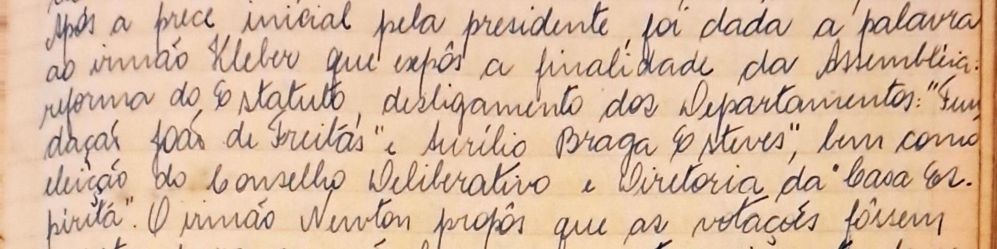
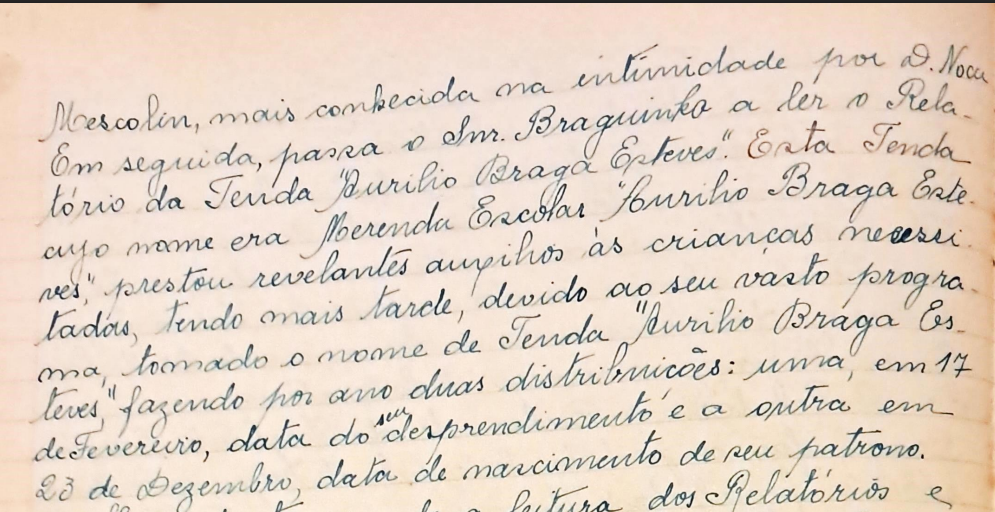
As shown in the minutes of the Ordinary General Assembly (AGO) of the Spiritist House1 held on May 26, 1951, the institution already had a department called the Aurílio Braga Esteves School Lunch Program, later renamed the Aurílio Braga Esteves Tenda, whose purpose was “to provide assistance to poor children,” by “distributing donations and clothing twice a year.” According to the minutes of May 26, 1952, these donations also included “sweets” and were distributed at the Spiritist House itself. The minutes of May 26, 1955, further document the sending of this assistance to the cities of São Paulo, Rio Pomba, Guarani, Rio Novo, and others.
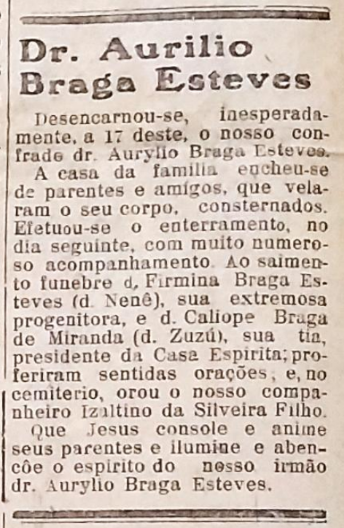
Although a brief search reveals more than one meaning for the word “tenda” in the mid-twentieth century, it seems to have been used here to refer to a workshop for handicrafts, which possibly produced some of the items that were donated.2 The name Aurílio Braga Esteves, meanwhile, was given in honor of a relative of workers at the Spiritist House. His name was also given to a theater group at the same institution. We found a reference to his passing (January 17, 1947) in the first issue of O Médium3 published that year. The text mentions his mother, Firmina Braga Esteves (Mrs. Nenê), and his aunt, Calliope Braga de Miranda (Mrs. Zuzu), who was then president of the Spiritist House. Other members of the Braga and Esteves families also appear frequently in the minutes from that period.
Although we found no earlier records, everything indicates that this department had already been operating at the Spiritist House for some time. Based on Aurílio’s date of passing, we believe it may have been established after 1947, at least under the name mentioned above. The minutes of May 26, 1953, in addition to recording the annual financial report of the “Tenda,” note a “growing volume” of activity. Perhaps for this reason, the minutes from the following year record the donation of a plot of land to the department, located in the São Pedro neighborhood: “in the future, God willing, a Center shall be built there, to be named Tenda Aurylio4 Braga Esteves.”
Although the minutes identify Guilherme Schaeffer as the donor, an official record at Viana Jr. Notarial Office lists the couple Curea and Mrs. Maria Eftinie as the owners of the land donated in 19555. Both this document and the minutes of the Spiritist House’s Ordinary General Assembly of May 1957 state that the property was not located in the São Pedro neighborhood, but in the Borboleta neighborhood, then known as Vila de São Vicente de Paulo. As these neighborhoods were still small and close to one another at the time, the mistake is understandable.
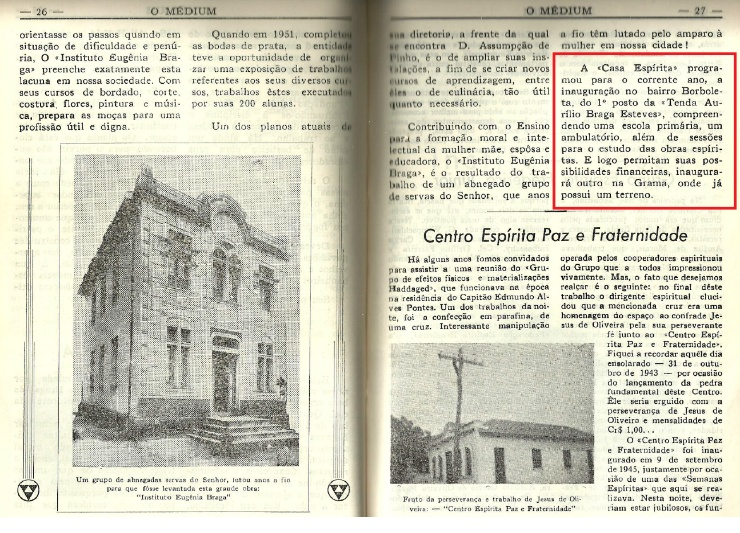
The minutes also record the beginning of construction of the center. According to the April 1957 issue of O Médium, “the Spiritist House planned to inaugurate the first Aurílio Braga Esteves Tenda outpost in the Borboleta neighborhood during the current year, comprising an elementary school, an outpatient clinic, as well as sessions for the study of Spiritist works.” The intention to open a second outpost in the Grama neighborhood was also stated, although we have no further information about it.
In May 1958, we find the name Aurylio Braga Esteves Foundation for the first time. The foundation was still under construction and therefore had not been inaugurated as planned in 1957. The efforts of Atanalpa Alves, Cristovam de Almeida, and Onofre Rodrigues de Oliveira; the latter being the Foundation’s first president are highlighted. Interestingly, the official change in the organization’s legal name from Tenda to Aurílio Braga Esteves Spiritist Foundation would only be formalized in 2012, according to the records of the Olavo Costa6 Notorial Office.
Following a previous request by Calliope Braga de Miranda, a former president of the Casa Espírita, the proposal to separate the Fundação João de Freitas and Fundação Aurílio Braga Esteves from the Casa Espírita appears in the minutes of October 21, 1962. After a vote, the majority decided in favor of the separation, on the date that is now celebrated as FEABE’s anniversary. The same minutes include a new statute for the Casa Espírita, whose Article 28 ratifies this decision. Its autonomy was also confirmed in a registration filed years later with the Laura Figueiredo Registry Office.7
The last set of minutes in which we found a reference to the now-independent FEABE is dated June 2, 1963. However, the president at the time pointed out that its own bylaws had not yet been registered and that, consequently, its assets still belonged to the Casa Espírita. Interestingly, he advocated for the reintegration of the FEABE building, which, in his view, should be sold to raise funds for renovations to the Casa Espírita. As the assembly did not support his proposal, the young FEABE continued to exist. To formalize its independence, its president, Onofre Rodrigues de Oliveira, registered its first bylaws and the minutes of its first Ordinary General Assembly (held on February 27, 1964), which elected its first independent board, on May 21, 19648. This concludes our first investigation.
Given the historical value of this material, we hope that this type of research will become more widespread. In the very minutes of the Casa Espírita that we investigated, we found names that would become more prominent in the future, as well as extensive information about the Dias da Cruz Spiritist Youth Group and the João de Freitas Spiritist Foundation, among other institutions and initiatives that are still active. For all these reasons, we strongly encourage all Spiritist centers to carefully preserve, digitize, and make this type of document available for public consultation online. They are excellent research materials, documenting the history of the Spiritist Movement.
Since then, much has changed at the Foundation. It is up to us to research the course of history in the minutes of the then-independent FEABE. We do not yet know how long the elementary school or the clinic will remain in operation, but the Foundation’s mission of providing assistance and promoting Spiritism will certainly endure. All of this research, however, is already very inspiring. We know that the work began long before our time and that it must continue, following the examples set by those early pioneers. Anyone who arrives today and sees FEABE expanded and organized as it is now cannot imagine the effort they must have expended. We are deeply grateful to all of them.
Much has changed at the Foundation since then. It is now up to us to research the minutes of the independent FEABE to trace the course of its history. We do not yet know how long the primary school or the clinic remained in operation, but its commitment to charitable work and the dissemination of Spiritism will certainly endure. The research itself, however, is already highly motivating. We know that the work began long before us and that it must continue, inspired by the example of those early workers. Anyone who arrives today and sees the expanded and well-organized FEABE of the present day could hardly imagine the effort they must have invested. We are deeply grateful to them all.
Congratulations, FEABE, on your 64th anniversary!
- “Casa Espírita” is the name of an important century-old Spiritist center located at 425 Sampaio Street, in downtown Juiz de Fora, Minas Gerais.
- There is no evidence indicating any connection with Umbanda or Candomblé temples, which sometimes use the word “tenda” in their names.
- All issues of the magazine are available on the website: https://omedium.amejf.org.br/.
- In the references, the name is sometimes spelled with an “i” and sometimes with a “y.”
- On May 17, 1955, folio no. 064-V of Book no. 265, according to a certificate issued by the Viana Jr. Notarial Office on October 21, 2013.
- Record no. 2653 (registration).
- On November 6, 1978.
- Certificate no. 590, Book A1, folio 0, of the Lucy de Figueiredo Hargreaves Registry Office.
O médium – April de 1957 (https://omedium.amejf.org.br/)
- O médium – January/February 1947 (https://omedium.amejf.org.br/)
Excerpt from the minutes of May 26, 1951
Excerpt from the minutes of October 21, 1962