

Mediumistic Receptor
Paulo Rogério Chaves F. Oliveira
The text addresses the relationship between the mind, spirituality, and the brain. Within the context of Spiritist literature, particularly the works of André Luiz, psychographed by Francisco Cândido Xavier, reflections are presented on the interaction between the Spirit, the perispirit, and the physical body, with emphasis on the role of the pineal gland in mediumistic phenomena.
Works such as Missionaries of the Light and The Mechanics of Mediumship describe mediumship as a process of mental attunement, comparing thought to electromagnetic waves and processes and drawing analogies with Physics and Biology to explain communication between incarnate and discarnate beings.
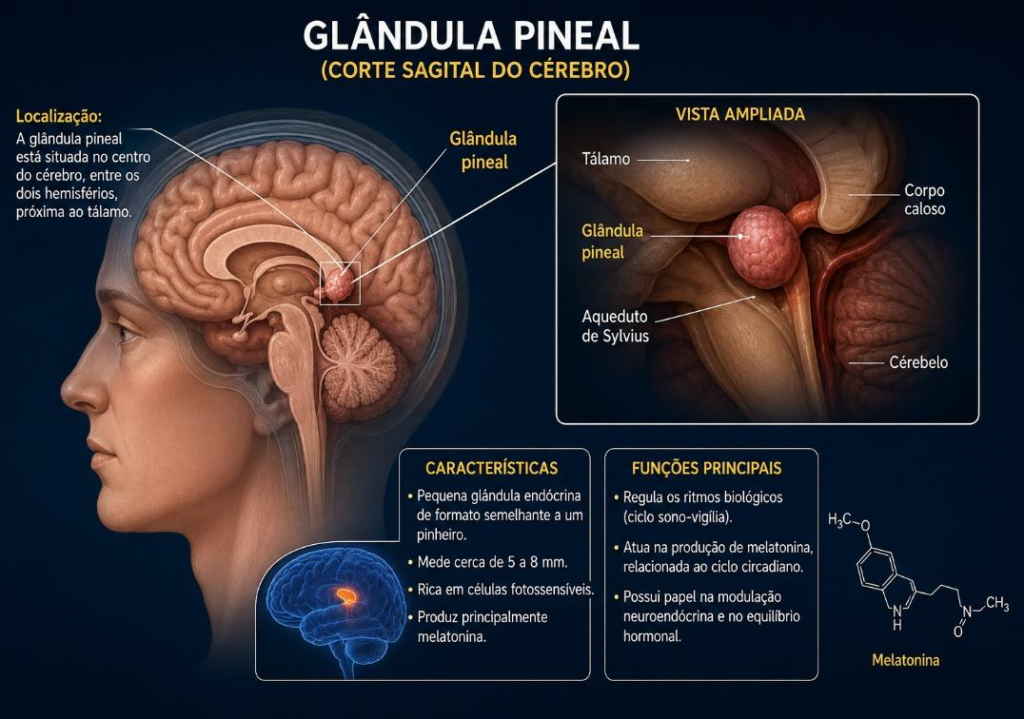
Within this context, the pineal gland (or epiphysis) is highlighted. Science recognizes it as a neuroendocrine gland responsible for the production of melatonin and the regulation of biological rhythms. From the Spiritist perspective, however, it is presented as an important center of connection between mind and body, being described by André Luiz as the “gland of mental life.”
Contemporary authors, such as Décio Iandoli Júnior, expand upon this interpretation by suggesting that the pineal gland functions as an “antenna” between consciousness and the physical brain, mediating the reception and expression of information from the Spirit through the perispirit, without being the origin of mediumship itself.
Thus, the study proposes to examine the hypothesis that the pineal gland may act as an “antenna” connecting the mind and the organism, functioning as a participating element in the reception and expression of mediumistic phenomena and in the transmission of thoughts.
————————————
In Life in the Spirit World, André Luiz addresses topics such as the existence of a spiritual colony, the Umbral, the passe, the pineal gland or epiphysis, the ocean and its energy and vitality, and the magnetism of the ocean. He brings together concepts from Science, Physics, and Biology with spirituality.
The book The Mechanics of Mediumship, in turn, aims to demystify mediumistic phenomena in the light of Science and Physics. It explains how the brain, mind, and perispirit interact, combining the study of spirituality with scientific rigor. It also provides detailed accounts of mediumistic phenomena, comparing them to electromagnetism and the emission of mental waves. It employs concepts such as nuclear chemistry, atoms, conditioned reflexes, and ideoplasty (the ability of thought and will to shape and materialize fluids or energies, creating forms and objects or even altering the appearance of the perispirit).
Based on these works, as well as The Spirits’ Book, The Mediums’ Book, and Genesis, we will attempt to establish a connection between the pineal gland as a “mediumistic antenna” and the reception of waves and frequencies.
Pineal gland or epiphysis
(imagem ChatGPT)
The pineal gland was identified as an active neuroendocrine transducer, particularly after melatonin was isolated in 1958 by American dermatologist Aaron Lerner.
Eastern traditions—especially Hinduism and yogic traditions—promote the symbolic idea of the “third eye,” associated with the concept of the ajna chakra (also known as the third-eye chakra, the sixth of the seven major chakras in yoga and Tantric traditions). It should be noted that the “third eye” is not an anatomical description of the pineal gland, but rather a spiritual representation of inner perception and intuitive consciousness.
The direct association with the pineal gland is a modern interpretation, developed through dialogues between spirituality (the works of André Luiz) and neuroscience, rather than a single, literal classical teaching about the pineal gland dating back “two thousand years.” Moreover, the medical understanding of its physiology is based on a relatively short period of research (1954 to 1965). It is currently one of the structures most extensively studied by science, according to a scientific article published in the journal Neuroendocrinology in 2013.
In Spiritist literature, a reference work on the subject is Missionaries of the Light, by André Luiz, which pioneered the discussion. At the time, not even Science itself had yet reached a position on the study of the pineal gland.
The idea that the pineal gland may be related to the perception of “subtle energies” and interaction with energetic centers known as chakras is commonly believed. Within this framework, the pineal gland is often symbolically described as a “point of interface” between psychic dimensions and the physical body. These descriptions, however, belong to a spiritual model for interpreting reality, rather than to a biological model supported by experimental evidence.
The pineal gland may be understood, within this spiritualist interpretation, as a structure of a subtle and symbolic nature, associated with the perception of information originating from the soul or intelligent principle, transmitted to the physical body through the perispirit or other subtle bodies.
In Chapter 2 of Missionaries of the Light, André Luiz describes the pineal gland as the “gland of mental life,” stating that it governs the nervous phenomena associated with emotionality and constitutes an important center of connection between the mind and the physical organism.
“The more I observed the brain’s details, the more I marveled at the increasing light the pineal gland was emitting. The tiny gland had become a radiating nucleus and its rays formed a lotus flower of sublime petals around it.”
“and I realized that very delicate vibrations were in play, imperceptible to me.”
“the pineal gland as the gland of a person’s spiritual life.”
We can therefore say that the pineal gland functions as a kind of “biological antenna” for spiritual perceptions. This statement is consistent with the thought of Décio Iandoli Jr. in his book Da Alma ao Corpo (From Soul to Body, our translation).
“The pineal gland is, therefore, a crystalline sensory structure that receives information from the Soul, or intelligent principle, through the subtle bodies or perispirit. Based on this, we take the liberty of theorizing about the neurophysiological mechanism of mediumship based on the pineal gland, whereby information received from higher planes would pass to the thalamus and subsequently be projected onto the right hemisphere of the brain, the seat of man’s creative and intuitive potential.”
“The pineal gland, being the primary source of communication between the physical and spiritual planes, would, if removed, result in significant impairment of the manifestations of the Soul, such as creativity, emotions, intuition, among others.”
“In our understanding, the pineal gland is the preferred pathway for the manifestations of the Soul, particularly those closest to manifest consciousness, and is therefore the fastest and most effective pathway, but not the only one, for this contact with physical reality.”
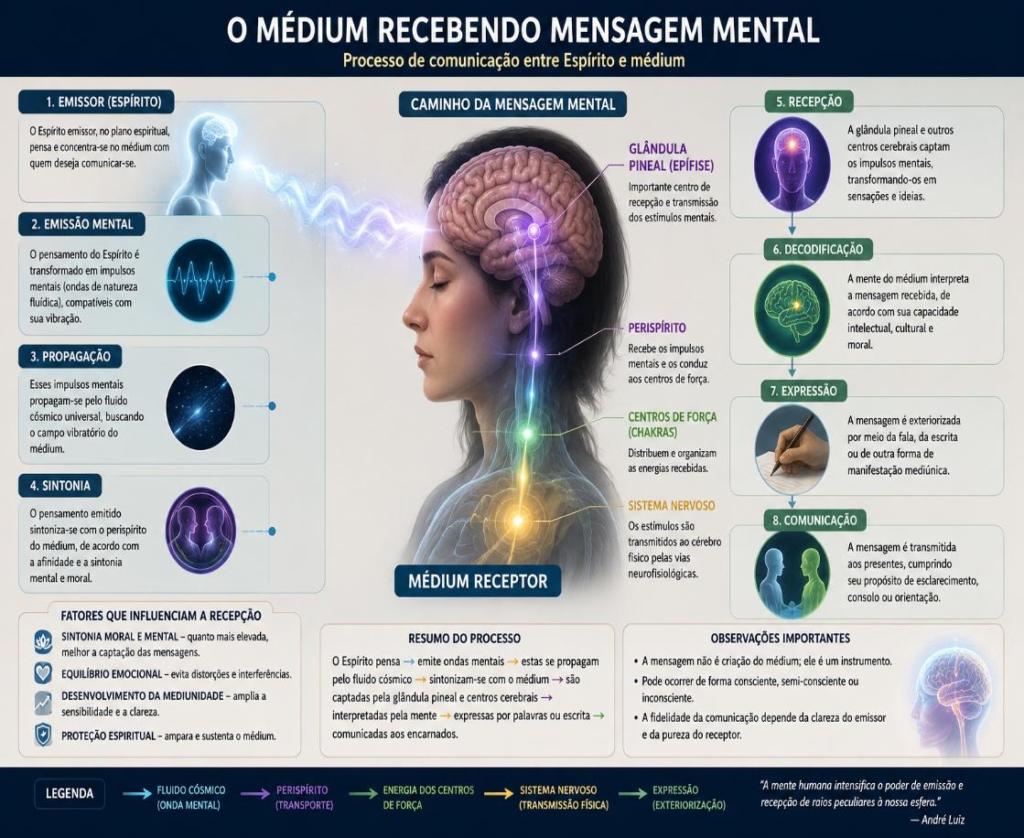
In the work The Mechanics of Mediumship, mediumship is explained as a process of mental attunement, in which thoughts propagate in the form of waves and mental fields. According to this Spiritist interpretation, the Spirit is the actual sender and receiver; the perispirit is an intermediary; and the pineal gland is one of the main points through which these perceptions reverberate in the physical brain. Mediumship, therefore, does not originate in the pineal gland, but uses the pineal gland as an instrument of manifestation.
(imagem ChatGPT)
It is worth remembering that we are all mediums in a broad sense, because we all influence and are mentally influenced by others. Ostensible mediums merely display greater sensitivity and a greater capacity to externalize these perceptions.
The pineal gland participates in this process as an important neuroendocrine center through which mental and spiritual activities reverberate, functioning as a true “antenna” of the Spirit through the perispirit and mental attunement. In this way, the pineal gland would function as one of the main points of interface between the mind (Spirit) and the physical organism.
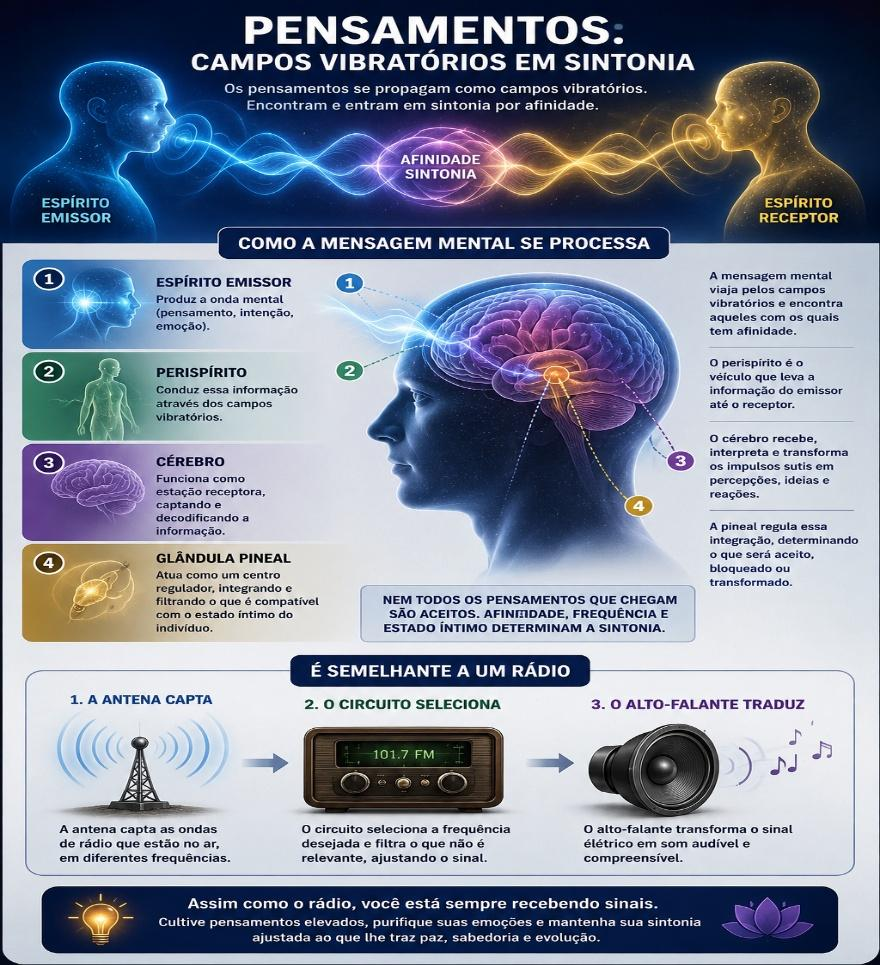
According to Spiritist literature, thought is an emission of consciousness endowed with its own vibrational characteristics. Thus, thoughts of hatred, fear, and resentment tend to generate denser attunements, while thoughts of peace, love, and fraternity favor higher attunements, influencing spiritual exchange according to the Law of Affinity.
In this regard, we find the following passage in Studying Mediumship, by Martins Peralva:
“The Spirit’s thought, before reaching the medium’s physical brain passes through the perispirit’s brain, resulting in the medium ability, IN THEORY, to do or not do what the entity intends.”
(imagem ChatGPT)
In conclusion, from a Spiritist perspective, particularly according to the works cited throughout this text, we can say that the pineal gland functions as an “antenna” interfacing between the mind (Spirit) and the physical organism.